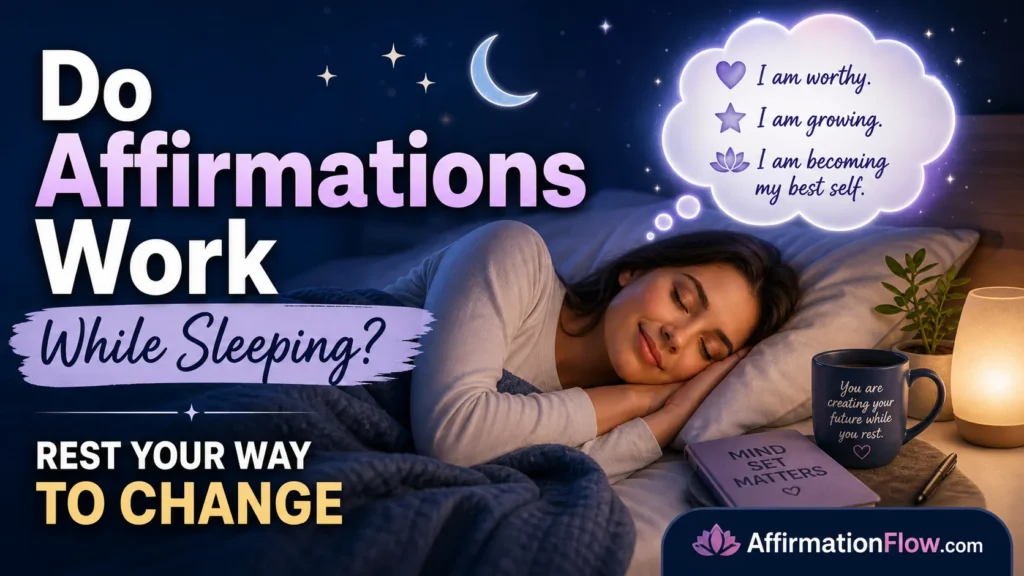
You’ve probably heard about the power of positive affirmations. But do affirmations work while sleeping? The short answer is yes, and the reason might surprise you.
Your conscious mind may rest at night, but your subconscious never stops working. It continues processing, sorting, and storing information even as you dream.
This creates a unique window of opportunity. During sleep, your analytical mind steps aside. Your subconscious becomes more receptive to new patterns and beliefs.
Why Your Sleeping Brain Loves Affirmations
Think of your conscious mind as a gatekeeper. During waking hours, it questions everything. It filters information through your existing beliefs and past experiences.
This gatekeeper serves an important purpose. It protects you from random ideas that don’t align with who you are. But it also blocks helpful new beliefs.
When you sleep, that gatekeeper takes a break. Your subconscious mind operates with less resistance. This makes it easier for affirmations to sink in deeply.
Sleep happens in cycles. You move through light sleep, deep sleep, and REM stages throughout the night. Each stage offers different benefits for affirmation work.
During light sleep, your brain remains somewhat aware of external sounds. This is when sleep affirmations can register most directly. Your mind hears the words without the usual mental chatter.
Deep sleep focuses on physical restoration. Your brain consolidates memories and processes emotions. Affirmations planted earlier continue working at this level.
REM sleep brings dreams and deeper subconscious processing. The positive messages you’ve absorbed blend into your mental landscape. They become part of how you see yourself and your world.
The Science Behind Sleep Learning
Researchers have studied sleep learning for decades. The technical term is hypnopaedia. Early studies showed mixed results, but modern research tells a more nuanced story.
A 2014 study at Northwestern University found that the sleeping brain can form new associations. Participants learned information paired with specific sounds. When those sounds played during sleep, the learning strengthened.
Swiss researchers discovered that playing foreign language vocabulary during sleep improved recall. The effect worked best during non-REM sleep stages. Participants remembered words better than the control group.
Your brain doesn’t learn complex new information during sleep. But it can reinforce existing knowledge and simple associations. Affirmations fit this category perfectly.
You’re not trying to learn calculus or a new language while sleeping. You’re repeating simple, positive statements. These statements align with goals you’ve already set consciously.
This repetition during sleep strengthens neural pathways. The affirmations become more automatic. They require less effort to believe and embody.
How to Use Affirmations During Sleep
Getting started with sleep affirmations is simpler than you might think. You don’t need expensive equipment or complicated techniques. Just intention and consistency.
First, choose your affirmations carefully. Pick three to five statements that resonate with your current goals. Keep them short, positive, and in present tense.
Examples include statements like “I am confident and capable” or “Abundance flows easily to me.” The simpler the phrase, the deeper it penetrates.
Record yourself speaking these affirmations. Use a calm, soothing voice. Speak slowly with pauses between each statement. This creates a gentle rhythm that supports relaxation.
Set your recording to loop or use one of many apps designed for sleep affirmations. The audio should play at a low volume. You want to hear it without it disrupting your sleep.
Some people prefer guided affirmation meditations that include relaxing music or nature sounds. Others want just the spoken words. Experiment to find what works for you.
Play your affirmations as you fall asleep. Let them continue through the night or set them to play for an hour or two. Your subconscious will absorb them either way.
Morning affirmations can complement your nighttime practice. When you wake up, your brain transitions from subconscious to conscious. This transition moment carries power.
What Makes Sleep Affirmations Different
Daytime affirmations require active participation. You speak them aloud or write them down. You engage your conscious mind and will.
This conscious engagement brings certain benefits. You feel empowered taking deliberate action. You create momentum through your own voice and energy.
Sleep affirmations work differently. They bypass conscious resistance altogether. You don’t need to believe them initially. You just need to allow them.
Many people struggle with affirmations because of internal skepticism. A voice inside whispers “this isn’t true” or “who are you kidding?” That voice quiets during sleep.
The repetitive nature of sleep affirmations also matters. Your subconscious hears the same positive messages dozens or hundreds of times per night. This creates deep imprinting.
You might say an affirmation ten times during a morning routine. During sleep, you might hear it one hundred times. The sheer volume makes a difference.
Sleep affirmations also work on the emotional body. They seep into your dreams and nighttime processing. You may notice your dreams becoming more positive and empowering.
Common Experiences and What to Expect
Starting sleep affirmations often brings subtle shifts first. You might wake up feeling more optimistic. Your internal dialogue may soften slightly.
Some people report vivid dreams related to their affirmations. If you’re affirming abundance, you might dream about receiving gifts or finding money. These dreams reinforce the new belief.
Others notice changes in their waking thoughts. The affirmations pop into their heads randomly during the day. This shows the subconscious is actively integrating the messages.
The timeline varies by person. Some feel different within days. Others need several weeks of consistent practice before noticing shifts.
Quality of sleep matters too. If the audio disrupts your rest, it defeats the purpose. The volume should be barely audible. You should still sleep soundly.
Most people adapt quickly. After a few nights, the affirmations become comforting background sound. They may even help you sleep better by quieting mental noise.
Track your progress in a journal. Note any changes in mood, opportunities, or self-perception. Small shifts compound over time into significant transformation.
Combining Sleep Affirmations with Other Practices
Sleep affirmations work powerfully on their own. But combining them with other spiritual practices amplifies their effect. Think of it as layering your manifestation work.
Morning visualization pairs beautifully with nighttime affirmations. Spend five minutes each morning visualizing what your affirmations describe. This engages both conscious and subconscious minds.
Gratitude practices also enhance sleep affirmation work. Before bed, list three things you’re grateful for. This primes your subconscious for positive reception.
Energy clearing techniques help too. Sage your bedroom or use crystals like amethyst for peaceful sleep. A clear energetic space allows affirmations to settle more deeply.
Meditation before sleep creates an ideal state. Even five minutes of breathwork quiets the mind. You enter sleep more peacefully, making affirmations more effective.
Some people combine sleep affirmations with binaural beats or solfeggio frequencies. These sound frequencies may deepen the subconscious programming. Research continues on their effectiveness.
The key is consistency across all practices. Sporadic efforts produce sporadic results. Daily commitment creates lasting change.
Addressing Doubts and Resistance
You might wonder if this is too passive. Perhaps you believe manifestation requires active effort and conscious focus.
Both approaches have value. Active daytime work creates momentum and intention. Passive nighttime work removes resistance and allows integration.
Together, they create a complete practice. You plant seeds consciously during the day. You water them subconsciously at night.
Some worry about manipulating their subconscious. They fear overriding their authentic self with artificial programming.
This concern shows healthy self-awareness. The solution is choosing affirmations that genuinely align with your values and desires. Don’t affirm anything that feels fundamentally wrong.
Your subconscious protects your core identity. It won’t accept programming that violates your deepest truth. You’re not brainwashing yourself. You’re removing limiting beliefs.
Others question whether change without conscious awareness counts. If the shift happens during sleep, does it really belong to you?
Change is change, regardless of when it occurs. You still set the intention. You still chose the affirmations. The timing of integration doesn’t diminish your agency.
Real Stories of Nighttime Transformation
Sarah struggled with self-worth for years. Daytime affirmations felt hollow. She couldn’t get past the feeling of lying to herself.
She tried sleep affirmations focusing on self-love and worthiness. Within three weeks, she noticed she stopped apologizing unnecessarily. Her posture improved. She started accepting compliments gracefully.
The changes felt organic, not forced. She didn’t consciously try to behave differently. The new patterns simply emerged naturally.
Marcus used sleep affirmations for financial abundance. He’d grown up with scarcity mindset. Money anxiety kept him in a job he’d outgrown.
After two months of nightly affirmations, he felt drawn to update his resume. Opportunities appeared that matched his skills. He negotiated a salary he previously would have considered impossible.
He credits the sleep work with dismantling his unconscious blocks. The affirmations worked beneath his waking resistance.
These stories aren’t guarantees. Everyone’s path differs. But they illustrate the potential of subconscious reprogramming during rest.
Making It Work for You
Start small. Choose one or two affirmations that address your most pressing need. Trying to change everything at once dilutes your focus.
Give it time. Commit to thirty days minimum. Subconscious shifts take consistent repetition. Brief experiments won’t show the full potential.
Pay attention to resistance. If you feel strongly opposed to trying this, examine why. Often resistance points to exactly what we need.
Customize your approach. Some people prefer their own voice on recordings. Others like professional guided meditations. Some want silence with just occasional affirmations.
Trust the process. You won’t feel different every morning. Some days nothing seems to change. Then suddenly you realize you’ve been thinking differently for a week.
Be patient with yourself. Spiritual growth isn’t linear. You might have breakthroughs, plateaus, and even temporary setbacks. All of it contributes to lasting change.
Remember that sleep affirmations support your growth. They don’t replace conscious effort. Use them as part of a holistic approach to becoming who you want to be.
Frequently Asked Questions
How long should I listen to affirmations while sleeping?
You can listen all night or just the first hour. Both approaches work well for subconscious programming.
Can sleep affirmations replace daytime affirmation practice?
They complement rather than replace daytime practice. Using both creates stronger, faster results than either alone.
What volume should I use for sleep affirmations?
Keep the volume low enough to sleep comfortably but audible enough to hear. Barely perceptible works perfectly.
How many affirmations should I include in one session?
Three to five affirmations work best. This allows enough repetition of each statement for deep integration.
Will sleep affirmations affect my sleep quality?
Most people sleep better with affirmations. If you experience disruption, lower the volume or try shorter sessions.
Your subconscious mind is always listening, always learning, always growing. Sleep offers a sacred space for transformation without the interference of doubt or fear.
Give yourself permission to receive positive messages while you rest. You spend roughly a third of your life sleeping. Why not use that time to become the person you want to be?
Tonight, as you lay down to rest, remember that you’re not just sleeping. You’re planting seeds of change in the fertile soil of your subconscious mind. Those seeds will bloom in ways that surprise and delight you.