
The 55×5 manifestation method involves writing a specific affirmation 55 times per day for 5 consecutive days. The goal is to shift your subconscious beliefs through focused repetition. It works best when paired with emotional clarity and a statement written in the present tense, as if the desire has already happened.
Write one present-tense affirmation 55 times a day for 5 days to train your subconscious mind toward what you want.
Why does manifestation feel like it never works for some people?
You’ve been there. You wrote the affirmations, made the vision board, and still woke up to the same life three months later. That kind of disappointment is real, and it’s worth taking seriously instead of brushing off with more positivity quotes.
The 55×5 manifestation method gets a lot of hype online, but most guides skip the part that actually makes it work. They hand you a template and call it a strategy. This guide won’t do that. Instead, it’ll walk you through the method honestly, including what the research actually supports, where people go wrong, and what to do differently this time.
Whether you call it the 55×5 method, the 5×55 manifestation technique, or scripting affirmations, the mechanics are the same. And when done right, there is a reason people keep coming back to it.
Where did the 55×5 manifestation method originally come from?
The method doesn’t have a single verified origin. It grew out of the broader law of attraction movement and is often loosely tied to numerology, where 5 represents change and 55 is seen as a symbol of amplified transformation.
What gave it staying power, though, wasn’t the numerology. It was the structure. Unlike vague visualization practices, 55×5 gives you something concrete to do every day. That specificity turns an abstract idea into an actual ritual, and rituals are something the human brain responds to very well.

The 5-day window is also practical. It’s long enough to create momentum but short enough that it doesn’t feel like a lifetime commitment. For people who have given up on manifestation practices before, that matters a lot.
What is the psychology behind writing affirmations 55 times a day?

Here is the part most guides quietly skip over: this method is not really about the universe receiving your signal. It is about your own brain changing its default settings.
Research on habit formation consistently shows that repetition changes neural pathways. When you repeatedly engage with a specific thought or behavior, you strengthen the connections associated with it.
Psychologist Phillippa Lally’s research at University College London found that it takes an average of 66 days to form a habit, but shorter bursts of intense repetition can still prime the brain toward new patterns of thinking.
When you write something 55 times, you are not just repeating words. You are making a deliberate choice 55 separate times to return your attention to one idea. That act of returning attention is itself a form of mental training.
Here is the counterintuitive part: the writing matters more than the believing. Most people wait until they feel the affirmation is true before they write it with conviction. But the repetition is actually what generates the feeling over time, not the other way around. You don’t need to believe it yet. You need to show up anyway.
The common misconception is that manifestation is passive, that you write something and wait for results to appear. The real mechanism is active.
The writing shifts your attention, your attention shapes your perception, and your perception influences the choices you make and the opportunities you notice.
How do you do the 55×5 manifestation method step by step?
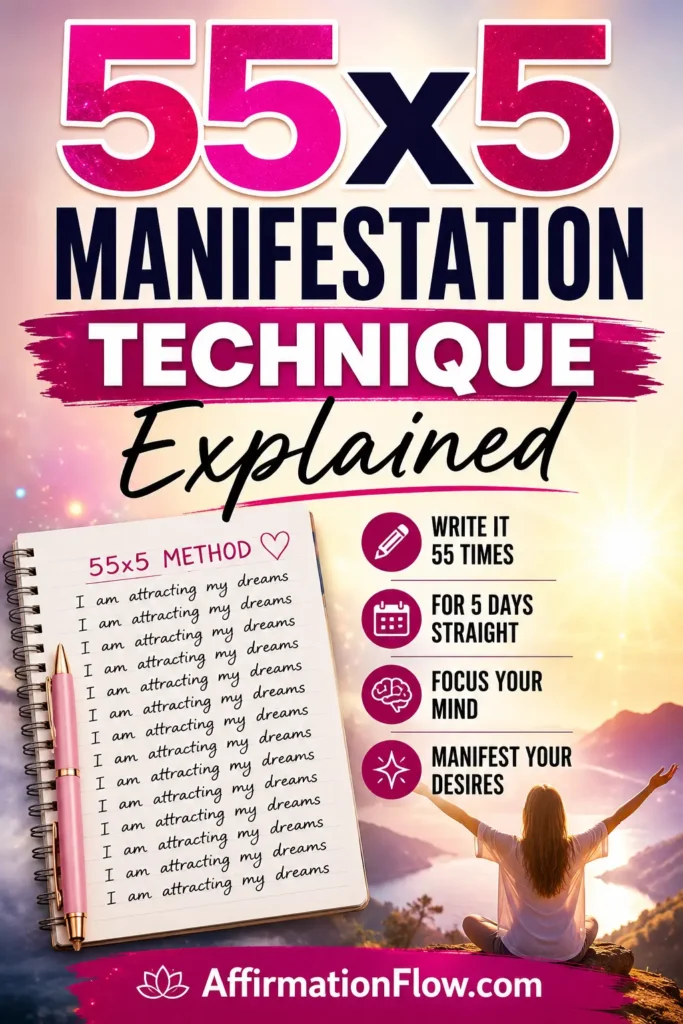
Follow these steps carefully. Each one has a reason behind it.
- Choose one specific desire. Not a category of desires. One thing. Vague affirmations produce vague results because your brain has nothing precise to latch onto.
- Write it in present tense. Instead of ‘I will have,’ write ‘I have’ or ‘I am.’ This isn’t semantic wordplay. Present tense creates a different felt sense in the body when you write it.
- Keep it under 17 words. Long affirmations become something to recite rather than feel. Short statements land differently. ‘”I am confidently building a business I love”‘ is better than a paragraph.
- Write it by hand, 55 times. Not typed. Handwriting engages more of the brain and requires more deliberate attention. Use a dedicated notebook, not scrap paper. The physical act carries more weight than people expect.
- Do this every day for 5 consecutive days. Consistency matters more than perfection. If you miss a day, restart from day one instead of skipping ahead.
- Don’t obsess over the outcome afterward. Once the five days are done, let it go. Continuing to check whether it is ‘working’ shifts your energy from trust to anxiety, which counteracts the mental training you did.
- Take aligned action in your daily life. This is where the method becomes real. The writing shifts your mindset. Your mindset needs to be followed by choices that match it. Action and mindset are not separate categories.
What are the best tips for making the 55×5 method work every day?
A lot of people start strong and trail off by day three. These practices help you stay consistent and get more out of each session.
- Set a specific time each day. Morning works well for most people because the mind is fresh. Evening works if you want to prime your subconscious before sleep. Pick one and stick with it.
- Add brief emotion to each line. Don’t just write mechanically. Pause for a half second on each line and try to feel even 10 percent of what it would feel like if this were already true. That small emotional charge is what separates this from rote copying.
- Use a tool to track consistency. Plenty of people use habit trackers or apps to stay accountable. I personally use AffirmationFlow to keep my daily practice organized across different goals, which takes the mental load off remembering to check in.
- Create a quiet environment. Notifications, background noise, and interruptions dilute the focus that makes this practice meaningful. Even ten minutes of silence makes a difference.
- Number each line as you write. It sounds small, but counting keeps you present and prevents the session from becoming a blur of automatic writing. Knowing you are on line 38 of 55 keeps your attention engaged.
- Reflect for two minutes after you finish. Write a sentence or two about how you felt during the session. Over five days, this reflection becomes a record of how your relationship to the affirmation shifts, and that shift is the actual evidence that something is happening.
What mistakes do people make with the 55×5 method that stop it from working?
Most failed attempts come down to a handful of recurring patterns. Recognizing them upfront saves a lot of frustration.
- Writing a desire they don’t actually believe is possible. There is a difference between stretching toward something and writing something so far from your current belief that every line produces internal resistance. Start with a desire you can at least imagine being true.
- Changing the affirmation mid-cycle. Pick one and commit to it for all five days. Switching statements partway through scatters your focus and resets the subconscious momentum you built.
- Treating it as a box to check. Writing 55 lines as fast as possible to get it done defeats the purpose entirely. Speed is the enemy of the attention this practice requires.
- Expecting visible results within the 5 days. The 55×5 method is not a five-day transformation. It is a five-day investment in a mindset shift that plays out over the weeks that follow. Impatience during the window is one of the biggest energy leaks.
- Taking no action outside the writing sessions. The method changes how you think. Changed thinking without changed behavior is just a nicer inner monologue. The writing is supposed to inspire action, not replace it.
Frequently Asked Questions
Q1. Does it matter if I type my affirmations instead of writing them by hand?
Handwriting is strongly recommended. Studies on note-taking show that writing by hand activates deeper cognitive processing than typing. With the 55×5 method, that deeper engagement is part of what makes the repetition meaningful. Typing works in a pinch, but it tends to produce faster, more automatic sessions with less emotional connection.
Q2. Can I do the 55×5 method for multiple goals at once?
You can, but it is not recommended during the same five-day window. The method works partly because it narrows your focus to one desire. Splitting that attention across two or three affirmations divides your mental and emotional energy. Run one complete cycle, then start a new one for a different goal if needed.
Q3. What should I do if I miss a day during the 5-day cycle?
Start over from day one. This is not a punishment. Continuity matters for the subconscious momentum you are building. Skipping a day and continuing from day three is like starting a meditation streak and counting a missed day as a rest day. The restart policy keeps the practice honest.
Q4. How do I write a good affirmation for the 55×5 method?
Use present tense, keep it specific, and make it something you want rather than something you want to avoid. ‘I am building a thriving career doing work I love’ is stronger than ‘I no longer hate my job.’ Positive framing, brevity, and emotional resonance are the three ingredients of an affirmation that holds your attention for 55 lines.
Q5. Is there scientific proof that the 55×5 manifestation method works?
Not for the method itself specifically. However, there is solid research supporting the underlying mechanisms: repetition changes neural patterns, written goal-setting improves outcomes, and focused attention shapes behavior. The method essentially packages these mechanisms into a structured daily practice. Whether you call it manifestation or mindset training is a matter of framing.
Q6. Can I use the 55×5 method for health, relationships, or money specifically?
Yes, the method applies to any goal. The key is writing an affirmation specific to that area that feels genuinely desired and at least partially believable. For health, something like ‘My body heals and grows stronger every day’ works well. For relationships or money, the same logic applies: specific, present-tense, emotionally resonant.
Q7. What time of day is best for doing the 55×5 scripting practice?
Morning or evening tends to produce the best results. Morning capitalizes on a calm, pre-stimulation mind state before the day’s noise sets in. Evening works because your subconscious remains active during sleep and can process the intention overnight. The most important factor is not timing but consistency. Whatever time you pick, protect it.
So, is the 55×5 method actually worth trying again?
If manifestation hasn’t worked for you before, the answer might not be that manifestation is fake. It might be that the version you tried was incomplete.
The 55×5 manifestation method, done with intention, emotional engagement, and aligned action, is one of the more grounded daily affirmation practices available. It doesn’t ask you to passively wish for things. It asks you to train your attention, shift your beliefs, and move through your days differently as a result.
That is not magic. That is how minds and habits actually change. And for people who have been burned by vague advice before, that distinction matters.
Give it five days. Not with fingers crossed, but with genuine presence on every single line.