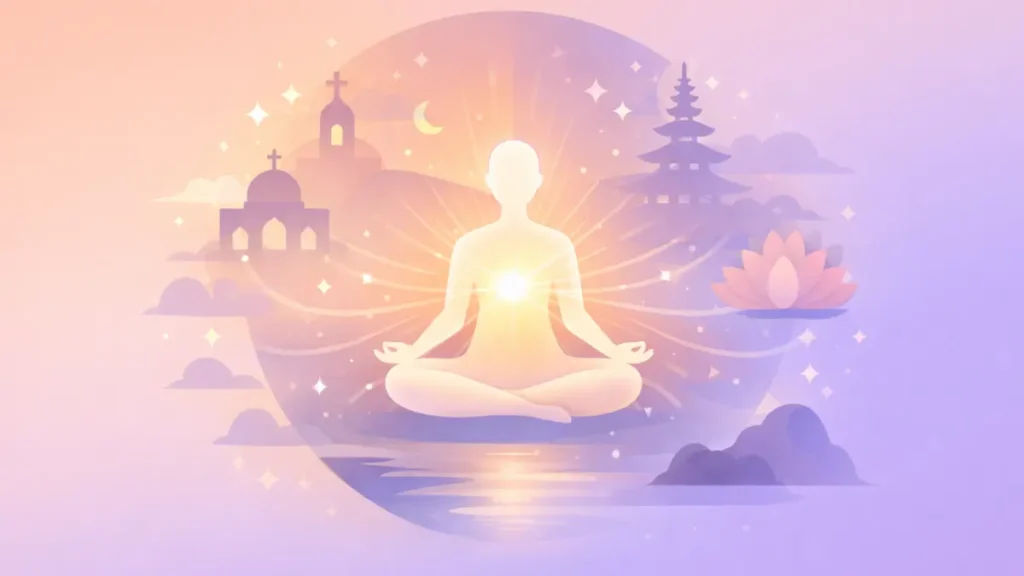
Every major religion claims to hold the key to enlightenment, salvation, or spiritual awakening. Billions of people follow sacred texts, perform rituals, and attend services in search of deeper meaning.
Yet there’s a profound truth that sits quietly beneath all religious doctrine, rarely spoken aloud by spiritual authorities. This truth doesn’t invalidate religious practice, but it does fundamentally change how we understand our relationship with the divine.
The truth is simple but radical: you don’t need an intermediary to access spiritual truth. No priest, guru, temple, or sacred text stands between you and direct spiritual experience.
This realization has been quietly known by mystics across all traditions for millennia, yet institutions have every reason to keep it from becoming common knowledge.
Why Religious Institutions Avoid This Spiritual Reality
Religious organizations exist as structures of authority, community, and tradition. These aren’t inherently negative functions.
They preserve wisdom, create belonging, and provide moral frameworks that help societies function. But institutions also have a tendency to centralize spiritual power in ways that benefit their continuation.
When spiritual authority becomes concentrated in clergy, temples, or specific practices, it creates dependency. Followers are taught they need proper guidance, correct interpretation, and official channels to reach spiritual heights.
The message becomes clear: you cannot trust your own direct experience without validation from those who know better.
This dynamic appears across traditions. Catholics are told the Church mediates between humanity and God. Many Buddhist schools insist on lineage transmission through authorized teachers.
Islamic scholars position themselves as essential interpreters of divine law. Hindu traditions often emphasize the absolute necessity of a guru for spiritual progress.
The pattern reveals something uncomfortable. While these traditions hold genuine wisdom, their institutional forms have incentive to position themselves as indispensable.
A seeker who realizes they can access spiritual truth directly becomes less dependent on external authority. They might still value community and teaching, but the relationship fundamentally shifts from necessity to choice.
The Historical Suppression of Direct Spiritual Experience
History is filled with mystics who threatened religious establishments by claiming direct communion with the divine. Their crime wasn’t heresy in belief but rather the assertion that ordinary people could access spiritual truth without going through proper channels.
Christian mystics like Meister Eckhart faced condemnation for teaching that God could be directly experienced within. Sufi poets were persecuted by orthodox Islamic authorities for describing union with the divine.
Buddhist teachers who emphasized sudden enlightenment available to all were marginalized by schools that preferred gradual, teacher-dependent paths.
These weren’t theological disagreements. They were power struggles about who controls access to spiritual truth.
When someone claims that enlightenment, salvation, or divine connection is immediately available through direct experience, it undermines institutions built on graduated hierarchies of spiritual authority.
The suppression took many forms. Direct spiritual experiences were reframed as requiring expert interpretation. Mystical states were pathologized as delusion or possession unless validated by authorities.
Sacred texts were declared too complex for ordinary understanding. Layer after layer of necessary intermediation was built between the seeker and the sought.
What Direct Spiritual Access Actually Means
Direct spiritual access doesn’t mean rejecting all teaching or guidance. It means recognizing that your consciousness already contains the capacity for spiritual realization.
You don’t need to earn this capacity or have it bestowed by another. It’s not a reward for proper belief or perfect practice. It’s your fundamental nature.
This truth appears in the core teachings of every major tradition, though often buried beneath institutional layers. Jesus taught that the kingdom of heaven is within you.
Buddha emphasized that enlightenment comes from your own investigation, not from believing what others say. Hindu Advaita points to your true nature as already divine. Sufi mystics speak of removing veils to reveal what was always present.
The direct path isn’t about acquiring something new but recognizing what you’ve always been. It’s not about becoming worthy but seeing through the illusion of unworthiness.
This recognition doesn’t require decades of practice, though practice can help. It doesn’t require perfect morality, though clarity naturally leads to more compassionate living.
What it does require is the courage to trust your own spiritual experience. To sit in meditation and honor what arises. To feel moments of profound connection and not dismiss them as insufficient because they didn’t happen in a church or temple.
To question teachings that don’t resonate with your direct understanding, even when presented by respected authorities.
The Role of Practice Without Institutional Dependency
Spiritual practices like meditation, prayer, contemplation, and mindfulness are valuable tools. They help quiet the mental noise that obscures our deeper nature.
They cultivate qualities like compassion, equanimity, and presence. But the value of practice doesn’t depend on doing it within a specific institutional framework.
You can meditate without a certified teacher. You can pray without a priest. You can contemplate existence without a guru’s permission. The practices work because of what they do to your consciousness, not because an institution has blessed them.
This doesn’t mean all approaches to practice are equally effective. Good instruction can save years of confusion. Community provides support and accountability.
Traditions preserve hard-won wisdom about common pitfalls and helpful techniques. But these are resources you can choose to use, not gatekeepers you must satisfy.
The shift is from seeking approval to seeking truth. Instead of asking whether you’re doing something correctly according to external standards, you ask whether the practice is actually transforming your consciousness and increasing your clarity.
You become the ultimate authority on your own spiritual development, while remaining humble and open to learning.
Reclaiming Personal Spiritual Authority
Taking back spiritual authority from institutions doesn’t mean arrogantly assuming you know everything. It means recognizing that ultimate validation of spiritual truth comes from direct experience, not from external approval.
When you read a sacred text and something resonates deeply, you don’t need a scholar to tell you it’s true. When you sit quietly and experience profound peace, you don’t need a priest to validate that you’ve touched something real.
When you feel genuine compassion arise spontaneously, you don’t need a guru to confirm you’re on the right path.
This shift requires developing discernment. Direct experience can be confused with wishful thinking, emotional states, or psychological projection.
Learning to distinguish genuine insight from mental fabrication is crucial. But this discernment develops through practice and honest self-reflection, not through outsourcing your judgment to authorities.
Personal spiritual authority also means taking responsibility. You can’t blame a tradition if its teachings don’t lead you to liberation.
You can’t hide behind a teacher’s instructions if your practice becomes mechanical and dead. You have to stay awake to your own experience and keep adjusting based on what actually works.
Living This Truth in a Religious World
Recognizing that you don’t need intermediaries doesn’t require abandoning religious community or tradition. Many people find value in belonging to faith communities while maintaining inner sovereignty. The key is participating by choice rather than from dependency.
You might attend church because the community nourishes you and the rituals connect you to something meaningful, not because you need a priest to access God.
You might study with a meditation teacher because their insights are helpful, not because you believe they possess something you lack. You might read sacred texts because they’re beautiful and wise, not because you need them to be inerrant truth.
This approach allows you to take what serves your growth while leaving what doesn’t. You can appreciate the wisdom in Christianity without accepting doctrines about hell.
You can practice Buddhist meditation without believing in literal rebirth. You can honor the beauty of Islamic devotion without submitting to religious law.
The freedom to engage spirituality on your own terms also means others have that same freedom. You’re not trying to convert anyone or prove them wrong. You’re simply living from your own direct understanding while respecting that others are on their own paths.
The Liberation in This Understanding
The realization that spiritual truth is directly accessible changes everything. Guilt imposed by religious authorities loses its power when you recognize that no human stands between you and the divine.
Fear of punishment for wrong belief dissolves when you understand that your spiritual worth isn’t conditional.
Desperation to find the right teacher, the right practice, or the right tradition relaxes. While you might still explore and learn, there’s no longer desperate seeking because you recognize that what you’re looking for is already present. The search shifts from acquisition to recognition.
This doesn’t make life suddenly easy or resolve all suffering. But it does remove a layer of unnecessary anxiety about whether you’re spiritual enough, whether you belong to the right religion, whether you’ve found the right path.
You can simply be present with what is, learning and growing naturally rather than forcing yourself into someone else’s mold.
The truth that no religion wants to emphasize is also the truth that sets you free. You are not separate from spiritual reality, waiting for permission to enter.
You are already here, already whole, already capable of direct knowing. Everything else is just scaffolding that can support the realization or obscure it.
What you do with this understanding is up to you. You might continue within religious traditions with new eyes. You might explore spirituality independently.
You might find that the whole question of spirituality transforms when approached from inner authority rather than external obligation.
The only requirement is honesty with yourself about what you actually experience, what actually transforms your consciousness, what actually opens your heart.
That honesty, sustained over time, becomes its own spiritual path, requiring nothing but your sincere attention and willingness to see what’s real.