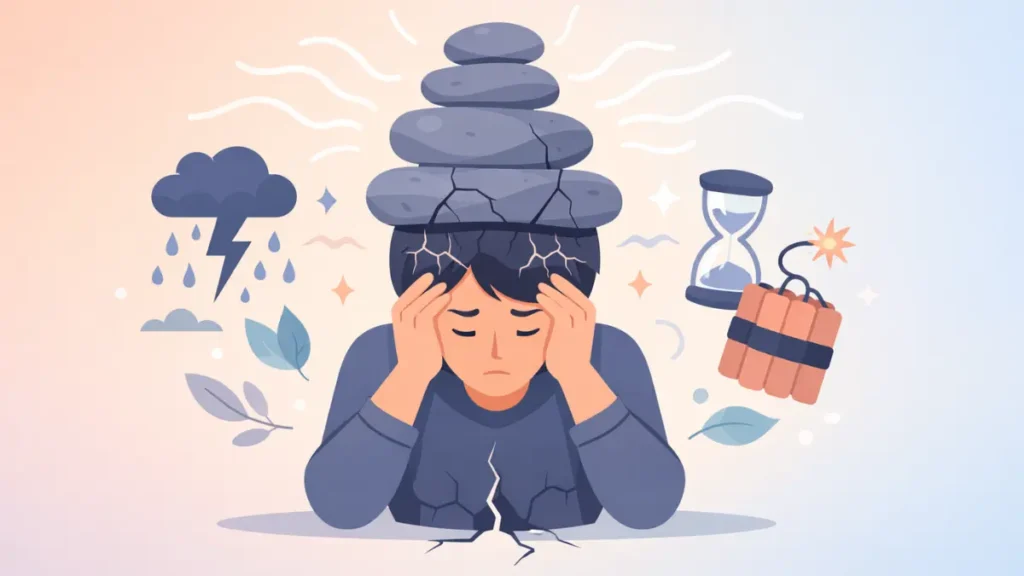
Strong people rarely look like they are breaking. They smile, they show up, they get things done. Their strength becomes a reliable currency in the world.
The people around them assume they are fine, because that is how strength presents itself: calm, competent, unbothered.
But silent pressure works differently. It does not explode. It accumulates. It builds in the body like sediment. And even strong minds, especially the strongest ones, can struggle under weight that seems invisible to everyone else.
This topic matters now more than ever. We live in a culture that celebrates resilience but rarely talks about the cost of maintaining it. Mental strength is treated like an identity instead of a muscle. When muscles overwork without rest, they tear. Minds do too.
Below is an exploration of why silent pressure breaks strong minds, how strength is misunderstood, and what modern psychology understands about the coping mechanisms that eventually stop coping.
Silent Pressure and High Functioning Stress
Silent pressure often hides under performance. It looks like someone who can juggle work demands, relationship roles, and personal goals simultaneously. On the surface, this looks like mastery. Underneath, it is often survival through efficiency.
High functioning stress has its own language. It says things like:
- “I’ll handle it”
- “I’m fine”
- “Others have it worse”
- “I can’t afford to slow down right now”
These statements create a protective shell. They also delay internal needs. The body might be tired, but the mind says “not yet.” This mismatch creates friction between what is felt and what is projected. That friction becomes pressure.
Studies in behavioral psychology describe this as adaptive overcompensation. The coping strategy works, but only for as long as energy and emotional bandwidth exist.
The problem with silent pressure is that it is treated as chronic rather than temporary. Chronic stress reshapes the brain’s stress patterning and nervous system responses over time.
The Myth of Strong Means Unbreakable
Strength is culturally misunderstood. We tend to define it as the absence of struggle instead of the ability to move through it. A strong person is seen as someone who never falters, never complains, never needs help. This is a myth.
Real strength includes vulnerability. It includes collapse and rebuilding. A tower that never bends eventually snaps in a storm, while a tree that can bend in the wind survives.
The problem for silently strong individuals is that they internalize their own myth. They start believing that letting anyone see their emotional fatigue equals weakness. Even asking for help feels like betrayal of their character.
This myth becomes self-imposed imprisonment. The person becomes accountable not to their wellbeing but to an external performance of resilience.
Internal Expectations and Invisible Standards
Silent pressure thrives in people who carry invisible standards. These standards are rarely demanded by others. Instead, they are set internally:
- Be reliable
- Be emotionally composed
- Be self-sufficient
- Be the problem solver
- Be the one others depend on
There is dignity in these standards, but dignity is not the same as sustainability. Perfectionism does not always show up as a desire for flawless work.
Sometimes it shows up as a desire to avoid burdening anyone else. The perfection becomes emotional rather than functional.
Internal expectations also distort measurement. Success gets measured by what is handled privately, not what is shared publicly. Failure becomes defined as needing support.
When the mind can no longer meet its own conditions, it breaks quietly rather than loudly.
The Physiology of Silent Breakdown
Emotional strength has biology attached to it. Silent pressure activates the sympathetic nervous system. This is the fight or flight response that elevates cortisol and pumps adrenaline.
A healthy system toggles between sympathetic and parasympathetic states, between activation and recovery.
Strong individuals often stay in activation too long. They override signals like fatigue, irritability, and sensory overload. They learn to mentally dominate their body instead of listening to it. Over time this disconnect creates consequences:
- Sleep disruption
- Emotional numbness
- Anxiety spikes
- Reduced emotional regulation
- Cognitive fatigue
- Burnout
When burnout arrives, it does not look dramatic. It looks like indifference, withdrawal, or an inability to care about things that used to matter. It looks like someone who still gets through the day but feels no internal landscape during it.
This is why silent breakdowns go unnoticed. They are not loud enough to alarm others, only quiet enough to suffocate the one experiencing them.
Why Asking for Help Feels Dangerous for Strong Minds
Many strong individuals grew up being the emotional stabilizers in their environments. They were the children who adjusted to keep peace, or the adults who absorbed the burdens of others.
They learned early that resilience earns approval and that vulnerability risks disappointment.
Asking for help introduces fear:
- Fear of being misunderstood
- Fear of becoming a burden
- Fear of losing respect
- Fear of being perceived differently
Silent pressure teaches self-reliance to the point of isolation. The mind becomes accustomed to handling storms alone. The problem is not that help is unavailable. The problem is that the strong mind does not believe it is entitled to receive it.
The Social Problem: Applauding Strength but Ignoring Strain
Modern culture rewards productivity. It applauds those who are “busy but functioning.” Emotional struggles that do not disrupt output are rarely noticed.
Many strong people are high performers. They get promoted, praised, or admired for their stability. No one asks how much effort stability costs.
This creates a dangerous cycle:
- The strong person performs well.
- The world applauds them.
- The applause reinforces performance.
- The cost of performance increases.
- The pressure becomes identity.
- Identity resists change.
- Breakdown arrives as collapse, burnout, or emotional withdrawal.
By the time anyone notices, the person is already at their limit.
How Silent Pressure Finally Breaks
Breakdown does not always look like a dramatic crisis. It can look like:
- Cancelling plans
- Struggling to make small decisions
- Feeling detached from life
- Losing interest in things you once loved
- Emotional flatness
- Chronic fatigue
- Low tolerance to stress
- Sudden irritability
- Crying without clear trigger
Sometimes breaking is not about falling apart. Sometimes it is about the inability to keep holding things together.
Healing Requires Permission Not Performance
Strong people recover when they realize strength is not meant to be constant. It is meant to be cyclic: effort, rest, recalibration, rebuilding. Recovery demands permission to not perform strength every second of life.
Healing does not require dramatic change. It often involves subtle shifts:
- Allowing yourself to rest without justification
- Speaking honestly instead of sounding fine
- Saying no when capacity is low
- Letting others carry part of the weight
- Recognizing that asking for help honors strength, not destroys it
The silent pressure begins to dissolve when the strong mind stops defending its strength and starts defending its wellbeing.