Most of us think our exhaustion comes from the obvious things: work demands, relationship stress, lack of sleep, or the endless stream of task lists waiting for our attention.
But in my experience, the deepest emotional fatigue rarely comes from what we do. It comes from what we keep doing silently, without even noticing.
There is a habit almost everyone engages in, regardless of age or personality type, and it drains emotional energy more efficiently than a bad night’s sleep or a stressful job.
I’m talking about the habit of internal overprocessing. The constant silent reviewing of conversations, outcomes, what someone meant, how we should have responded, what might happen, and what could go wrong.
It’s subtle. It’s habitual. And it’s invisible from the outside because it happens privately, in our heads, in the small spaces of our day.
If you’ve ever ended the day feeling wired and tired at the same time, this might be the culprit.
The Real Meaning of Emotional Overprocessing
Emotional overprocessing is different from overthinking. Overthinking is noisy. It’s obvious. It feels like spinning mentally. Emotional overprocessing is quieter and more emotional in tone. It involves:
- Replaying conversations
- Decoding facial expressions and body language
- Anticipating others’ reactions
- Imagining future conflicts or disappointments
- Negotiating multiple hypothetical outcomes
- Mentally micromanaging relationships
- Trying to avoid emotional discomfort ahead of time
What drains us is not the thoughts themselves. It is the invisible emotional labor they require. You’re not just thinking. You’re managing feelings, expectations, fears, and imagined conflicts at the same time.
Our nervous system treats these imagined scenarios as if they’re happening, so even without real conflict, our stress hormones stay elevated.
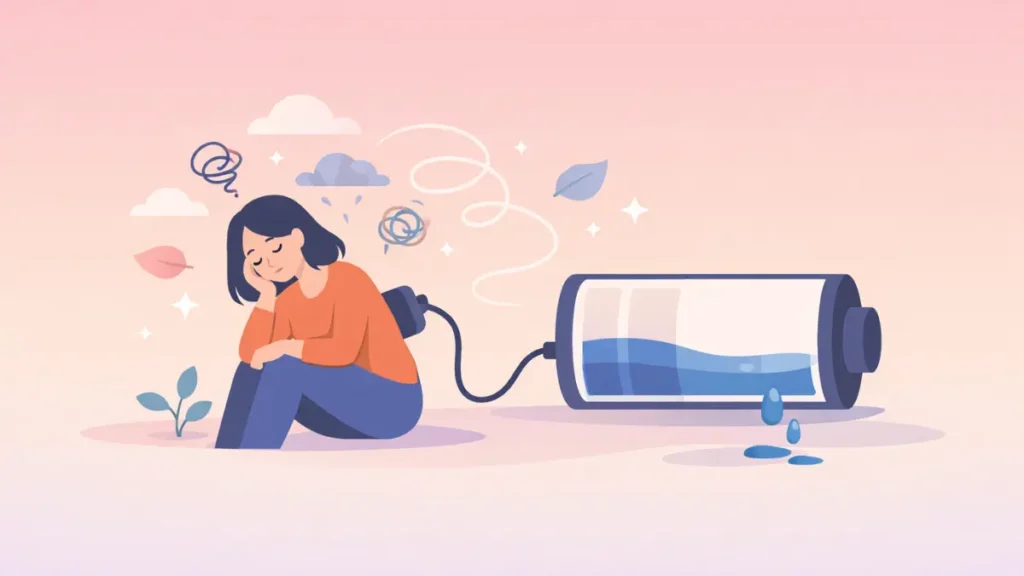
Over time this creates an emotional deficit. It’s like having a background app constantly running in your brain, draining battery even when the screen is off.
Why Emotional Overprocessing Becomes So Automatic
To understand why this habit forms, we have to go back to childhood. Most people learn emotional overprocessing as a survival strategy.
If you grew up in a household where the emotional weather shifted unpredictably, you became hyperaware of subtle cues.
If a parent’s tone changed or a sibling looked angry, your brain learned to scan for danger early. This anticipation helped you avoid conflict or secure approval.
That same strategy becomes a habit in adulthood, even when there is no real threat. And because now the “threat” is mostly imagined, the response never finds resolution.
You never get closure because nothing actually happens. Instead, your mind cycles through possibilities that never materialize.
I’ve met people who are high functioning, calm in public, successful in their careers, yet deeply drained by their internal world. They carry an intensity that others don’t see. Emotional overprocessing is their second job, unpaid and unending.
Silent Stress: The Nervous System Cost of Internal Processing
Emotional overprocessing activates our stress circuitry the same way perceived danger does. The nervous system isn’t sophisticated enough to differentiate between a real argument and a mentally imagined one.
If you rehearse an argument in your head, stress hormones respond as if the event is happening now.
This doesn’t just affect mental energy. It affects physical energy too. Emotional fatigue feels like:
- brain fog
- Heaviness in the body
- Procrastination
- Hypersensitivity to minor stressors
- Difficulty making decisions
- Craving social withdrawal
- Tired but restless sleep patterns
When emotional fatigue builds up long enough, it starts influencing how we show up in relationships. Small frustrations feel bigger.
Delayed responses from others feel personal. Decision-making becomes exhausting because every decision gets emotionally simulated before it’s made.
The Hidden Link Between Emotional Overprocessing and Approval Seeking
Most people don’t realize how deeply approval seeking fuels emotional overprocessing. When your emotional peace depends on the reactions of other people, your brain performs a constant social audit. It wants to ensure everything is smooth, conflict-free, and acceptable.
This makes your internal world a negotiation table. You start rehearsing who you need to be for the situation to go well. That habit is so rooted in many of us that we don’t even question it.
Approval seeking isn’t about vanity. It’s about safety. Humans are wired for belonging, so rejection feels like danger. Overprocessing becomes our attempt to prevent rejection before it occurs.
But there is a cost. You become exhausted trying to manage outcomes that aren’t in your control to begin with.
Overprocessing and Emotional Delayed Reactions
One of the strangest things about emotional overprocessing is how delayed our emotional reactions become. Instead of feeling things in real time, we archive them.
Later, when we’re alone, we process the interaction in detail. We analyze what we should have said and what they might have meant.
This delayed emotional processing creates a backlog. No wonder we feel drained. We aren’t just living our present life. We’re re-living the last 48 hours of conversations too.
The Impact on Relationships and Boundaries
Emotional overprocessing makes relationships harder because it keeps us in a state of imagined relational tension instead of direct relational connection. You may notice:
- you avoid asking for clarity
- You assume negative intentions
- You predict conflict instead of expressing discomfort
- You please instead of assert
- You apologize for things not needing apology
- You struggle with boundaries because boundaries require discomfort
Healthy relationships require direct communication. Emotional overprocessing avoids directness by negotiating everything internally first. It’s a habit that feels protective but actually creates distance.
Breaking the Habit: Emotional Awareness Without Emotional Micromanaging
The first step in changing emotional overprocessing is recognition. Not in an intellectual way, but in a sensory one. Notice what it feels like in your nervous system when you start rehearsing emotionally.
It often feels like buzzing energy in the chest, tightening in the throat, or shallow breathing. Emotional habits live in the body more than the mind.
When the habit begins, ask simple questions:
- Is this scenario actually happening?
- Does this belong to me or to my imagination?
- Is this problem present or predicted?
- Am I trying to avoid discomfort?
- Is there a conversation I’m rehearsing instead of having?
Not all emotional processing is bad. The goal isn’t to shut down emotional intelligence. It’s to stop micromanaging emotions that don’t need managing.
Letting Relationships Be Real Instead of Pre-edited
Relationships become easier when we stop rehearsing them beforehand. Most of the conflict we fear never happens. And the conflicts that do happen are more manageable than we imagine.
When we stop pre-editing ourselves, we begin showing up with more authenticity and less anticipation. We give people a chance to respond in real time, not in our simulations.
Authenticity is energizing. Pretending is exhausting. Overprocessing keeps us stuck in pretending mode.
Learning to Trust the Present Moment Again
Emotional overprocessing steals energy from the present moment. It pushes us into scenarios that don’t exist. The more we learn to trust the present moment, the less we need to predict the future.
Trust does not mean naivety. It means accepting that discomfort is part of life and that avoidance creates more suffering than discomfort itself.
If there is a hidden habit quietly draining emotional energy, it is not stress, conflict, or hard conversations. It is the avoidance of those things through internal rehearsal.
When we stop overprocessing, we don’t lose awareness. We gain peace. We gain energy. And we gain the ability to actually live the day we’re in instead of the day we fear.