
If you’ve ever walked away from a conversation feeling confused, drained, or somehow “less than,” you may have been dealing with a narcissist.
I say this not from theory alone, but from lived observation—friends, work environments, and relationships where something always felt off, even when things looked perfect on the surface.
Narcissism isn’t just about vanity or confidence. It’s a pattern of thinking, behaving, and relating to others that quietly erodes emotional safety.
This article is not about labeling people or throwing around psychological terms casually. It’s about awareness. When you can name what you’re experiencing, you can protect yourself.
Below are the 12 most common traits of a narcissist, explained in a grounded, human way—without jargon, without judgment, and without exaggeration.
1. Grandiose Sense of Self-Importance
One of the clearest narcissist personality traits is an exaggerated sense of importance. Narcissists believe they are more special, talented, or deserving than others—often without real evidence. They may:
- Constantly talk about their achievements
- Exaggerate success or status
- Expect recognition without effort
What makes this tricky is that it can initially look like confidence. But over time, you’ll notice that their self-worth depends on being seen as superior. If they aren’t admired, they become irritated or dismissive.
True confidence is calm. Narcissistic grandiosity is loud and fragile.
2. Constant Need for Admiration and Validation
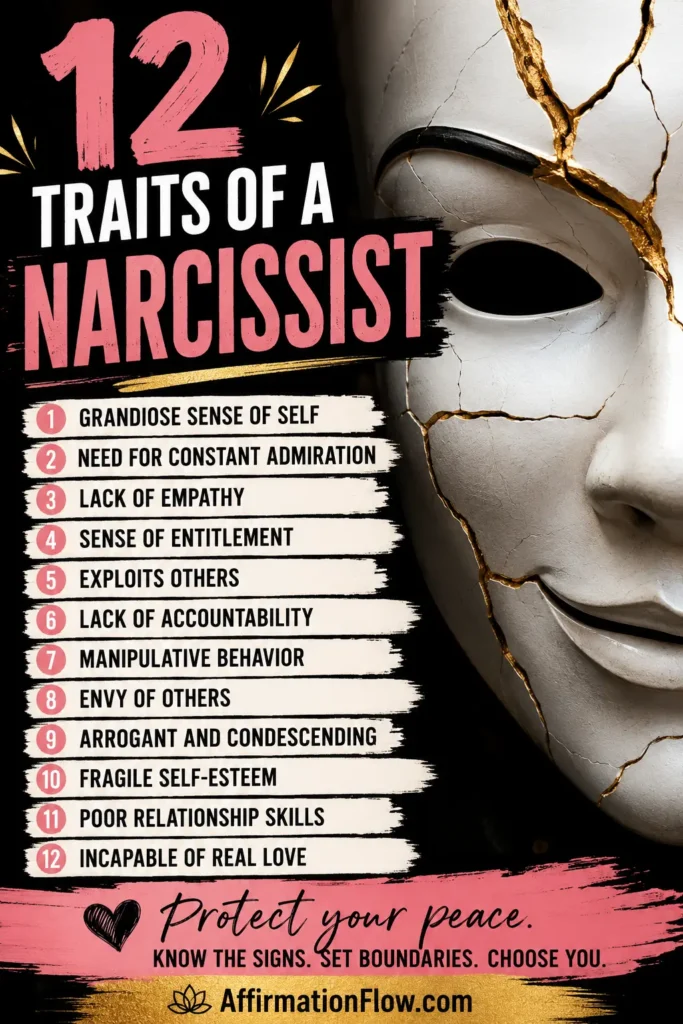
A narcissist doesn’t just enjoy compliments—they need them. This is one of the most exhausting traits of a narcissist in relationships. They seek:
- Praise, attention, and approval
- Social media validation
- Constant reassurance of their value
If admiration slows down, they may fish for compliments or provoke drama just to feel noticed. Over time, you may feel like your role is to emotionally “feed” them, while your own needs are ignored.
3. Lack of Empathy (Emotional Blindness)
Perhaps the most painful narcissistic trait is the inability—or unwillingness—to empathize. They struggle to:
- Understand your emotions
- Comfort you when you’re hurting
- Take responsibility for emotional harm
You might explain how something hurt you, clearly and calmly, only to be met with indifference, defensiveness, or ridicule. It’s not that they don’t hear you—it’s that your feelings don’t matter as much as their own comfort.
4. Sense of Entitlement
Narcissists often believe rules apply to everyone except them. This sense of entitlement shows up in subtle and obvious ways. They may:
- Expect special treatment
- Get angry when told “no”
- Believe they deserve more than others
This trait often reveals itself when boundaries are set. Healthy people respect limits. Narcissists feel offended by them.
5. Manipulative Behavior (Control Through Confusion)
One of the most damaging narcissist red flags is manipulation. Narcissists are skilled at controlling situations without appearing controlling. Common tactics include:
- Guilt-tripping
- Playing the victim
- Withholding affection
- Twisting facts
You may feel confused after conversations, questioning your own memory or intentions. This isn’t accidental. It keeps the narcissist in control.
6. Gaslighting (Making You Doubt Reality)
Gaslighting deserves its own space because of how deeply it affects mental health. A narcissist may:
- Deny things they clearly said or did
- Tell you you’re “too sensitive”
- Claim you’re imagining problems
Over time, this causes self-doubt and emotional dependence. You stop trusting your instincts and start relying on their version of reality.
If you’re constantly apologizing just to keep peace, pay attention.
7. Exploitative Relationships (Using People as Tools)
Narcissists often view relationships as transactions. This is a core trait of a narcissist in friendships and work environments. They may:
- Befriend people only for benefit
- Disappear when they no longer need you
- Take credit for others’ work
Once your usefulness fades, so does their interest. Genuine connection is replaced with convenience.
8. Extreme Sensitivity to Criticism
Despite appearing confident, narcissists cannot handle criticism—even gentle feedback. Common reactions include:
- Anger or rage
- Silent treatment
- Mocking or belittling
Instead of reflecting, they deflect. Instead of listening, they attack. Criticism threatens their fragile self-image, so they respond defensively.
9. Arrogance and Superiority Complex
Another clear narcissistic personality trait is arrogance. Narcissists often speak down to others, subtly or openly. They may:
- Interrupt frequently
- Dismiss other viewpoints
- Act condescending
This behavior isn’t confidence—it’s insecurity disguised as dominance.
10. Envy of Others (and Belief Others Envy Them)
Narcissists are often deeply envious, even while claiming others envy them. They may:
- Undermine your success
- Make backhanded compliments
- Compete instead of celebrate
If you achieve something, they may minimize it or redirect attention to themselves. Your growth feels like a threat to their identity.
11. Emotional Inconsistency (Hot and Cold Behavior)
One moment they’re charming and affectionate. The next, distant or cruel. This emotional unpredictability is a classic narcissist behavior pattern.
This keeps others:
- Seeking approval
- Walking on eggshells
- Emotionally off-balance
It creates trauma bonding—where the highs feel intoxicating and the lows feel devastating.
12. Refusal to Take Responsibility
Finally, narcissists rarely admit fault. Accountability feels like an attack. They may:
- Blame others
- Rewrite events
- Apologize only to end conflict, not to change
A real apology includes changed behavior. With narcissists, apologies are often empty words meant to regain control.
Why Recognizing Narcissistic Traits Matters
Understanding the 12 traits of a narcissist isn’t about diagnosing people. It’s about self-protection. When you recognize patterns, you stop internalizing blame. You begin to realize:
- You’re not too sensitive
- You’re not asking for too much
- You’re not imagining the harm
Awareness creates emotional distance. Distance creates clarity.
How to Protect Yourself from Narcissistic Behavior
You can’t change a narcissist, but you can change how you respond. Helpful steps include:
- Setting firm boundaries
- Limiting emotional exposure
- Trusting your intuition
- Seeking support
Healing begins when you stop trying to be understood by someone incapable of empathy.
Trust What You Feel
If something consistently feels wrong, it probably is. Narcissistic behavior thrives in silence and self-doubt. Naming the pattern gives you power. You deserve relationships where:
- Your feelings matter
- Communication feels safe
- Love doesn’t come with confusion
Understanding narcissism is not about blame. It’s about clarity, healing, and choosing yourself—without guilt.